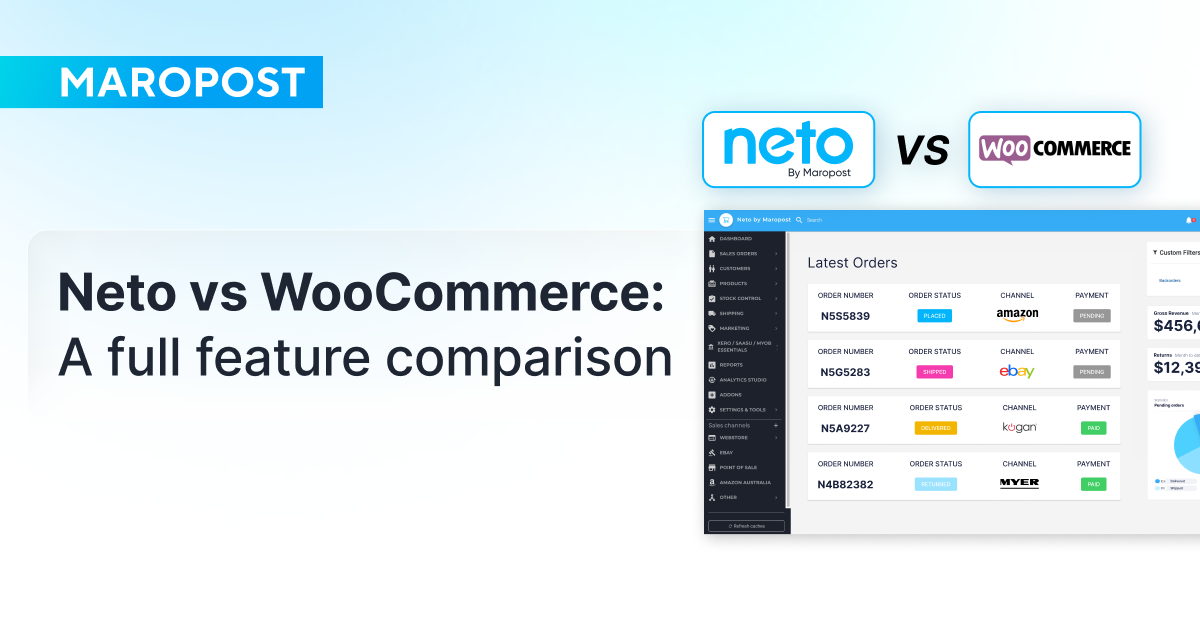
The choice between Neto by Maropost and WooCommerce comes down to understanding how these two ecommerce platforms fundamentally differ and who each one is best suited for. Both are popular ecommerce platforms in Australia and New Zealand – but they are built for different types of businesses and offer very different levels of flexibility and operational control.
While Neto stands out for operationally complex businesses that prioritise inventory accuracy, B2B workflows, multi-channel selling, and a single source of truth for all operations, WooCommerce shines when it comes to storefront flexibility and customisations.
In this article, we’ve put the two platforms side by side to help you better understand how they compare and which one is better for your specific business type and needs.
Two ways to run a commerce site: platform-native (Neto) vs WordPress + plugins (WooCommerce)
If you run a commerce business, both Neto and WooCommerce can power your online store, but they are built differently and cater to different business needs.
Neto is a strong option for businesses that want their ecommerce platform to act as the core system supporting key operations, including inventory management, fulfilment execution, and multi-channel selling – without relying on plugins and third-party integrations.
WooCommerce is essentially an open-source ecommerce platform built on WordPress. It works exceptionally well for businesses that view ecommerce as part of a broader WordPress-driven digital presence rather than as the core operational backbone.
Neto is a better fit for businesses that:
-
Rely on accurate, real-time inventory management, where stock errors, overselling, or cancellations directly impact revenue
-
Manage inventory across multiple locations, such as warehouses, retail stores, or 3PL providers
-
Operate both B2C and B2B/ wholesale channels using the same inventory and order management system
-
Sell on marketplaces as a core or growing revenue channel and need centralised control
-
Require operational control over purchasing, landed costs, and stock allocation
-
Want fewer disconnected systems and prefer a single platform acting as the main source of truth for all commerce operations
WooCommerce is a better fit for businesses that:
-
Rely on WordPress as the core digital platform for marketing sites, blogs, portals, or other initiatives beyond ecommerce
-
Need high levels of front-end flexibility, including bespoke themes and custom site experiences
-
Have relatively simple inventory requirements, or manage inventory through external systems
-
Have limited or no B2B requirements and primarily sell direct to consumers
-
Prefer to extend functionality through plugins rather than relying on built-in operational tools
-
Have strong internal WordPress expertise or work with a trusted development agency that can manage customisation and maintenance
Recommended: Here’s a quick look at how Neto and WooCommerce compare.
How Neto and WooCommerce stack up: an in-depth comparison of core capabilities
Now let’s break down how exactly Neto and WooCommerce differ in terms of features, capabilities, and what it means for Australian ecommerce merchants and retailers.
Storefront creation and customisation flexibility
This is where the fundamental difference between Neto and WooCommerce lies. Neto provides an all-in-one commerce platform with controlled customisation, while WooCommerce offers greater flexibility through its open-source architecture.
-
Neto provides built-in tools for storefront creation and customisation. It offers a library of industry-standard, mobile-responsive themes that can be fully customised using HTML, CSS, and JavaScript. This makes it a great choice for businesses that want a stable, high-performance storefront without the "plugin bloat" often found in other systems.
-
WooCommerce operates as an open-source WordPress plugin. You can create storefronts using thousands of WordPress themes, page builders like Elementor, or fully custom templates. Its large ecosystem of plugins and integrations allows merchants to extend functionality and design almost without limitation. This flexibility makes it suitable for businesses that want highly customised storefront experiences. On the flip side, however, using multiple plugins may result in slower site performance and a higher risk of plugin conflicts.
Hosting, security, and performance management
The key difference is that Neto provides fully managed hosting, performance, and security at the platform level, while WooCommerce requires merchant or agency-managed hosting and performance optimisation.
-
Neto takes complete responsibility for hosting, security, and performance management. Merchants do not need to worry about server optimisation or applying security patches, as Neto automatically manages all core platform updates behind the scenes. This reduces the technical overhead for merchants and minimises the need for dedicated infrastructure management.
-
WooCommerce is a self-hosted solution that requires the merchant or their agency to actively manage hosting environments and performance optimisation. Security and stability depend entirely on the user, who must perform ongoing maintenance, including regular updates to the WordPress core, plugins, and themes. While this offers the freedom to choose any hosting provider, it also demands significant technical oversight to ensure your store remains fast and secure.
POS (Point of Sale) management
When it comes to POS management capabilities, Neto provides a natively integrated POS system with seamless, real-time inventory synchronisation, while WooCommerce relies on third-party POS integrations whose functionality and synchronisation depend on the selected solution.
-
Neto treats Point of Sale (POS) as a fundamental part of its core operational system rather than an optional add-on. That enables real-time inventory synchronisation between physical stores and the online storefront. It also gives merchants a single, reliable source of truth for their stock levels and order data without needing to rely on third-party integrations and bridge separate systems.
-
WooCommerce does not include native POS capabilities and requires you to use third-party POS plugins or external POS systems. This flexibility allows merchants to select a POS interface that fits their specific needs and budget, but the quality of real-time inventory synchronisation and data integrity will heavily depend on the stability of the chosen plugin and its API connection.
Inventory, purchasing, and stock control
Neto provides built-in tools for inventory management, purchasing workflows, and stock control. WooCommerce relies on plugins or external systems to support advanced inventory management needs and achieve similar functionality.
-
Neto enables centralised inventory control without needing external ERP tools. It natively supports multi-location inventory management and enables stock allocation and reservation during order processing to help merchants prevent overselling. In addition, Neto provides built-in purchasing workflows like purchase order management and landed cost tracking.
-
WooCommerce does provide basic inventory management within its core platform, such as tracking stock levels and enabling simple stock status controls. But more advanced inventory operations (like multi-location stock management, stock allocation, and purchasing workflows) require additional plugins or external systems. As a result, inventory management becomes distributed across WooCommerce, third-party extensions, and external tools as your operational complexity grows.
Order processing, fulfilment, and shipping
Neto provides a natively integrated fulfilment and shipping solution highly optimised for the ANZ market, while WooCommerce requires merchants to build their own operational workflows using third-party plugins.
-
Neto is uniquely tailored for the Australian and New Zealand markets. It provides native integrations with local carriers like Australia Post, eParcel, StarTrack, and CouriersPlease and supports end-to-end order processing and fulfilment workflows, including order routing, warehouse pick/pack/ship processes, returns management, shipping rules, and label creation directly within the platform. Neto also natively supports complex regional requirements such as automated Australian GST handling, which makes it a top solution for ANZ merchants.
-
WooCommerce includes core order management capabilities such as capturing orders, managing order statuses, and basic shipping configuration. But advanced fulfilment workflows (like order routing, warehouse pick/pack processes, and returns management) require integrations with external Warehouse Management Systems (WMS) or specific extensions. For the ANZ market specifically, merchants must integrate external shipping aggregators (like Starshipit or Shippit) or purchase dedicated carrier plugins to generate labels and calculate live rates for local providers like Australia Post.
Payments and checkout flexibility
Neto provides more out-of-the-box payment integrations optimised for Australian retailers. WooCommerce offers a flexible toolkit that lets you build any checkout you can imagine if you’re willing to manage the technical setup.
-
Neto provides built-in integrations with key payment providers commonly used in Australia and New Zealand, including Stripe, PayPal, and local gateways such as eWAY, enabling merchants to accept major cards, digital wallets (Apple Pay, Google Pay), and Buy Now Pay Later services like Afterpay and Zip. It is reliable and handles complex local needs like B2B wholesale pricing and GST right out of the box.
-
WooCommerce delivers nearly limitless checkout flexibility, empowering developers to modify every single field, multi-step flow, and payment logic to suit highly specific business requirements. In the ANZ market, WooCommerce supports a range of payment gateways through individual extensions, including Stripe, Square, and Airwallex, but requires manual configuration and maintenance to ensure these "bolt-ons" remain compatible with your theme and other plugins.
B2B, wholesale, and account-based selling
Neto provides built-in B2B and wholesale functionality tailored to Australian trade businesses, while WooCommerce offers a flexible but maintenance-heavy toolkit that relies on external plugins to achieve the same professional B2B functionality.
-
Neto includes native B2B and wholesale capabilities designed for Australian distributors and trade businesses, including dedicated B2B portals, customer-specific price lists, and account-level ordering workflows. Merchants can assign wholesale price lists, manage customer groups, and provide credit terms, invoices, and account statements directly within the platform. That ensures Australian and New Zealand merchants can easily manage sophisticated wholesale relationships and account-based selling without having to patch together external add-ons.
-
WooCommerce treats B2B and wholesale selling as an extension of its core B2C platform, relying heavily on a network of third-party membership and wholesale plugins for account-based operations. While ANZ merchants can absolutely build tailored B2B portals with specific pricing rules and account approvals, stacking multiple plugins to achieve this can lead to technical complexities. This open-source approach offers incredible flexibility for highly customised B2B environments, but it demands ongoing technical maintenance to ensure the pieced-together extensions run smoothly.
Marketplace integrations: Australian edition
Neto provides native marketplace integrations with centralised catalogue and inventory management for Australian marketplaces, while WooCommerce relies on connector plugins for marketplace selling and cross-channel synchronisation.
-
Neto provides native integrations with major marketplaces used by Australian and New Zealand retailers, including Amazon, eBay, and regional marketplaces like Kogan, JB Hi-Fi, Bunnings, and MyDeal. Products, pricing, inventory, and orders can be synchronised automatically across all channels, allowing merchants to list products once and manage marketplace operations from a central catalogue within Neto. This makes Neto the number one option for ANZ merchants that sell actively across local marketplaces.
-
WooCommerce supports selling on marketplaces such as Amazon, eBay, and Kogan through third-party connector plugins (like CedCommerce or Marketplace Connect) or feed management tools. These connectors can publish product listings and sync orders or inventory, but reliability and functionality depend heavily on the specific extension used and how it is configured. As a result, catalogue data and channel operations become spread across multiple plugins, increasing the risk of stock discrepancies.
Comparing Neto and WooCommerce on the total cost of ownership (TCO)
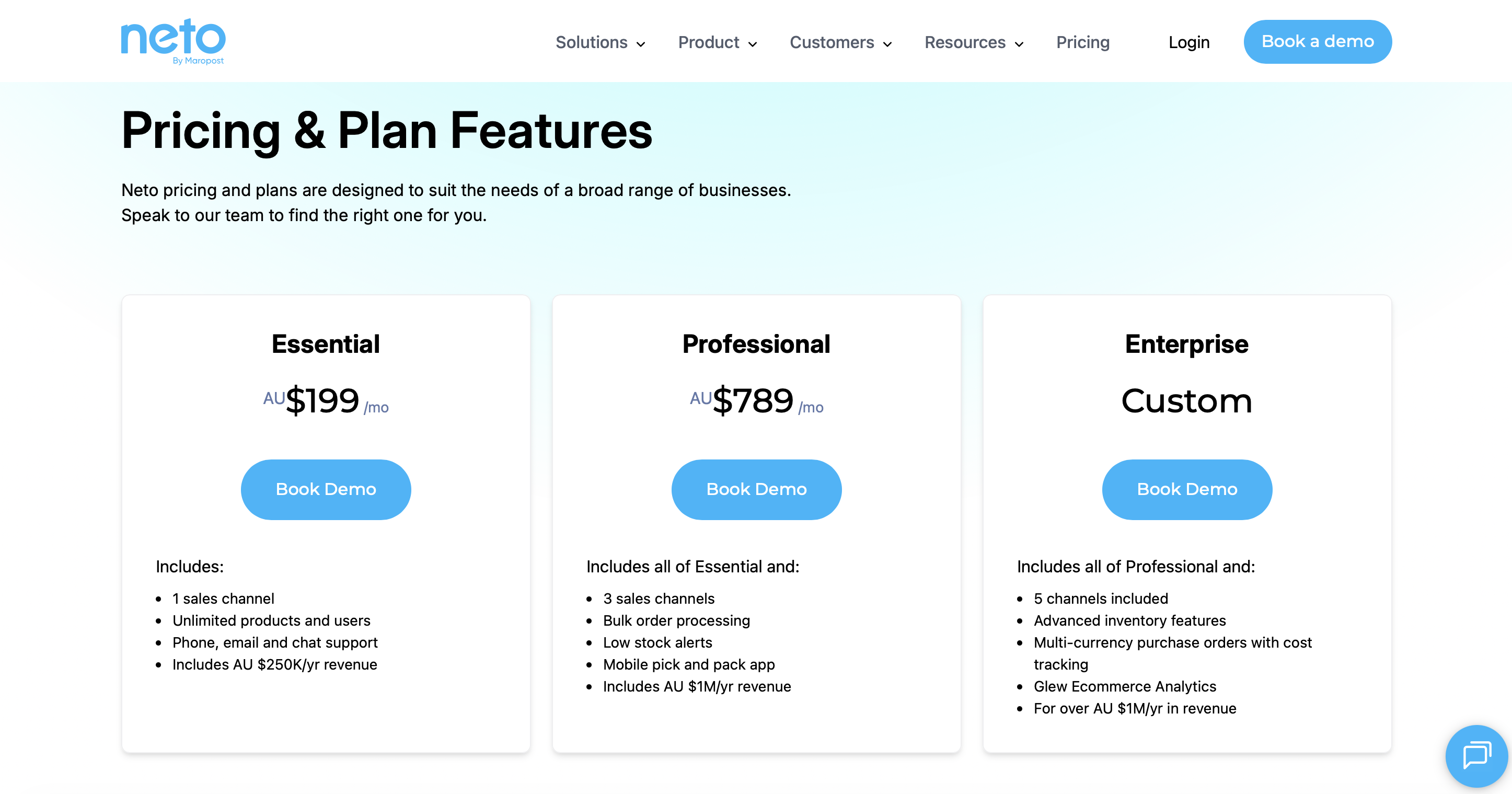
Neto uses a subscription model starting at around AU$199/month, which includes hosting, security, core ecommerce functionality, and many operational tools in one platform. And because advanced features like POS, complex inventory management, B2B/ wholesale workflows, and regional marketplace integrations are already built in, you can ultimately avoid the hidden costs of having to purchase separate third-party software.
Despite a higher monthly fee, lower developer reliance can make total costs more predictable for growing ANZ businesses.
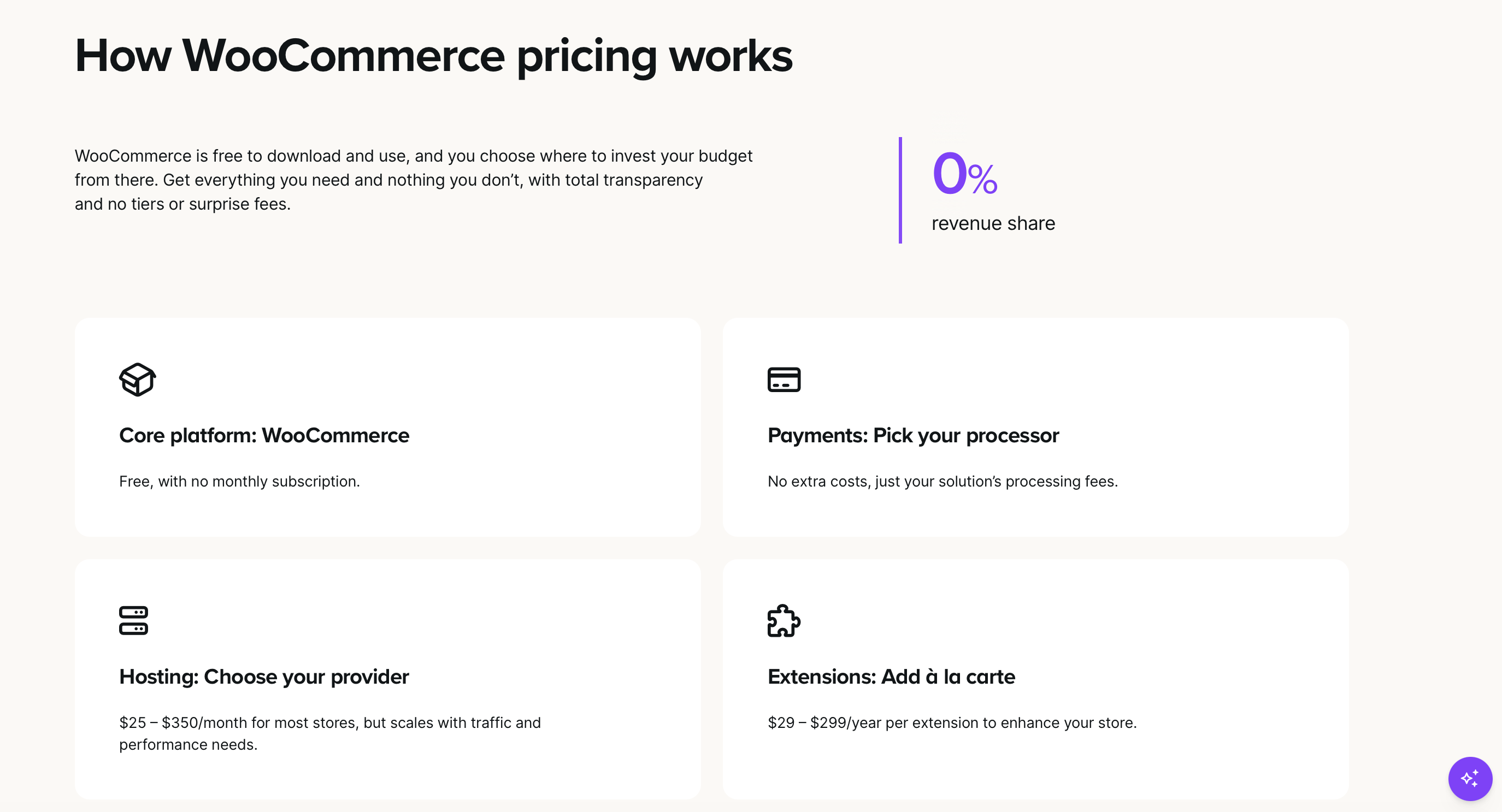
WooCommerce has an incredibly low barrier to entry because it’s technically free to install, but here’s how total costs can add up quickly:
-
Infrastructure costs: You must pay for high-quality, managed WordPress hosting. Plus, security, backups, and SSL certificates are often additional costs or managed by your host.
-
The "plugin tax": To match Neto’s native features, you will likely need a number of paid extensions, like a wholesale suite, a marketplace connector, and an advanced shipping calculator.
-
Maintenance and DevOps: The largest hidden cost is "human capital." Since you own the code, you (or a developer) must spend hours every month testing updates to ensure a WordPress update doesn't break your payment gateway or shipping plugin.
To sum it up, Neto offers more predictable costs through a single platform subscription, while WooCommerce starts cheaper but can become more expensive over time due to hosting, plugins, and development.
Neto or WooCommerce: what’s the best ecommerce software for Australian businesses?
Both Neto and WooCommerce might be great options for you to run your commerce business. As you’ve seen from the detailed comparison above, the final choice between Neto and WooCommerce ultimately depends on your business model, technical resources, and how much built-in functionality or flexibility you need from your ecommerce platform. The two solutions are just built for different operational models and business needs.
Choose Neto if you want an all-in-one unified commerce platform with built-in B2B, inventory, and marketplace integrations, and prefer a more predictable total cost of ownership with less reliance on third-party plugins and developers.
Go for WooCommerce if you want maximum flexibility and customisation capabilities, already use WordPress, and are comfortable managing plugins, integrations, and development to build your ideal ecommerce setup.
And when it comes to Australian retailers in particular, Neto offers a couple of undeniable advantages compared to WooCommerce and other popular ecommerce platforms:
-
Shipping: Direct, out-of-the-box connections to Australia Post, StarTrack, CouriersPlease, TNT, and other localcarriers. You can print labels and manifest orders directly from the dashboard.
-
Tax compliance: Handles GST, Australian tax invoicing, and recipient-created tax invoices (RCTIs) natively, ensuring you stay compliant with the ATO without manual workarounds.
-
Marketplace integrations: Natively integrates with eBay Australia, Amazon AU, Kogan, MyDeal, and other local marketplaces and ensures inventory and orders stay in sync in real-time across all channels.
-
Local support: Provides access to a customer support team based in your time zone with strong knowledge of the Australian retail environment.
Book a demo now to see Neto in action and learn how it can reduce your operational complexity, reliance on third-party apps and integrations, and the total cost of ownership by bringing ecommerce, POS, inventory, and marketplace management into a single unified commerce platform.
Frequently asked questions
Do Neto or WooCommerce charge transaction fees?
Neither Neto nor WooCommerce charges their own "per-transaction" commission fees, which distinguishes them from platforms like Shopify. However, you will still have to pay standard processing fees to your chosen payment gateway (e.g., Stripe, Afterpay, or PayPal).
When does it make sense to switch to Neto from WooCommerce?
Switching from WooCommerce to Neto makes sense for retailers who have outgrown WooCommerce and need stronger built-in inventory management, B2B/wholesale workflows, and multi-channel selling capabilities. Neto can also be a good choice when the technical burden and cost of maintaining multiple plugins and integrations begin to outweigh the benefits of WooCommerce’s flexibility.
Can I migrate from WooCommerce to Neto?
Yes, you can absolutely migrate your existing ecommerce store from WooCommerce over to Neto. You can opt for a CVS-based manual migration using Neto’s built-in data import tools, use automated migration services like LitExtension or Cart2Cart, or work with a specialised Australian agency to ensure a seamless transition of your products, customers, and order data.