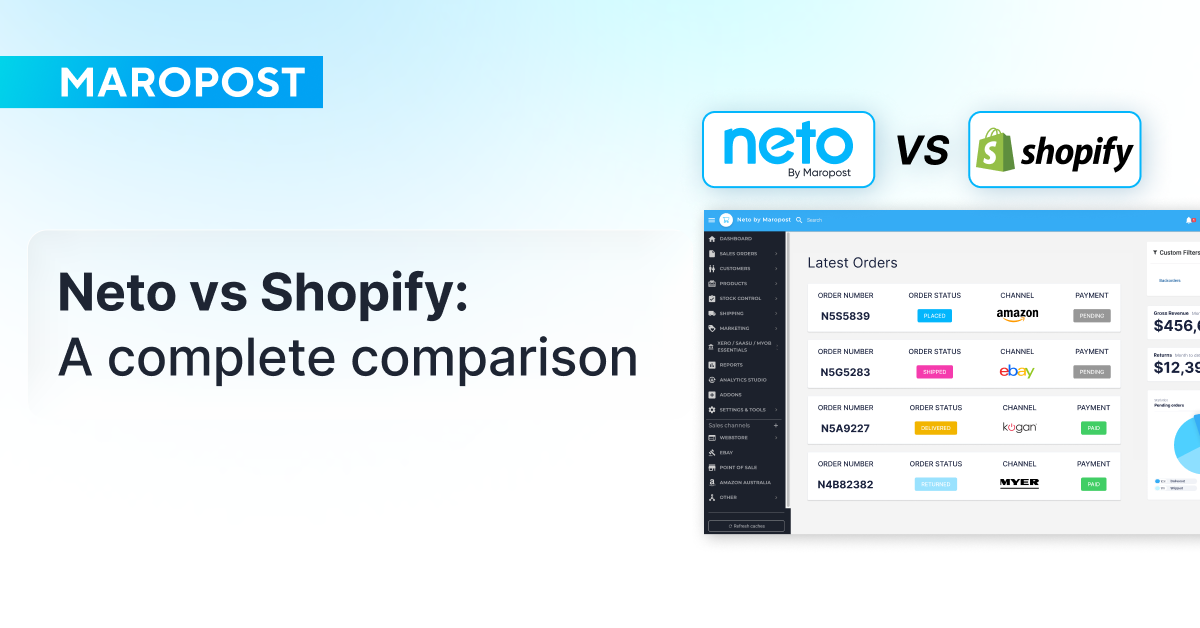
When it comes to scaling your ecommerce or retail business, picking the right commerce platform is the biggest operational decision you’ll ever make. In this article, we’re comparing the two leading commerce platforms in Australia – Neto by Maropost and Shopify – to help you choose the solution that best supports your long-term growth.
Many businesses choose Shopify early on because it’s simple and budget-friendly, but scaling usually involves piling on extra tools, which can make operations more complex and expensive over time. Neto is a strong option for merchants looking to move beyond Shopify, especially those who want to rely less on third-party apps and keep overall costs down.
Executive verdict: Neto vs Shopify in 30 seconds
-
Choose Neto if your business is operations-led and needs inventory accuracy, fulfilment precision, B2B/ wholesale workflows, and true multi-channel control without heavy app reliance.
-
Choose Shopify if you prioritise speed to launch over operational depth, run a primarily DTC business with low SKU and fulfilment complexity, and want maximum flexibility through apps.
-
Key differences: While Shopify relies on a vast library of third-party apps to extend its capabilities beyond storefront customization, Neto offers a "unified" architecture with ecommerce, retail, B2B wholesale, and logistics tools built directly into the core platform.
Recommended: See how Neto and Shopify compare on core features.
Two commerce platforms built for different realities – who is each best suited for?
Both Neto and Shopify are strong commerce platforms for Australian ecommerce and retail merchants – but they are essentially built for different realities and business needs. Neto provides built-in operational control across ecommerce, retail, B2B/wholesale, and marketplaces in one unified platform, while Shopify extends its functionality through apps and add-ons.
Who is Neto best for?
Neto is an operations-first commerce platform. It’s built around inventory, orders, warehousing, and multi-channel execution and is designed to help businesses reduce the number of systems required to run their day-to-day operations. Neto is best suited for:
-
High-volume retailers where inventory accuracy is business-critical
-
Businesses with complex product catalogues needing advanced categorisation and merchandising control
-
Businesses managing stock across multiple stores, warehouses, or 3PLs
-
Merchants running B2B/ wholesale alongside B2C
-
Marketplace-driven sellers requiring direct integrations and centralised control
-
Teams looking to reduce app sprawl, operational complexity, and rising subscription costs
Who is Shopify best for?
Shopify is a commerce-first platform. It’s optimised for fast setup and extensibility, with complexity handled through plan upgrades, add-on products, and third-party apps. Shopify is best suited for:
-
Startups and small ecommerce businesses prioritising speed to launch and ease of setup
-
DTC businesses with low SKU counts and simple fulfilment requirements
-
Teams seeking maximum flexibility through apps, agencies, and customisable themes
-
Brand-led businesses focused on content, marketing velocity, and customer experience
-
Drop-shippers leveraging app-based supplier and fulfilment integrations
Neto vs Shopify feature deep dives: where operations break or scale
Let’s now take a closer look at how each platform can handle the critical parts of your business:
Storefront flexibility and customisation
When choosing a platform for an ecommerce website in Australia, Shopify and Neto offer different approaches to the storefront experience.
-
Shopify's modern themes, intuitive section editing, and flexible content tools make it easy for teams to iterate quickly and customise their store’s appearance without needing developer support. It’s a strong fit for brands that care deeply about design, speed, and creating a polished online presence.
-
Neto storefronts can absolutely be customised – and for ecommerce teams with advanced technical knowledge, making those customisations won’t be challenging. But less tech-savvy users may need hands-on developer support for more advanced changes.
Inventory and order management
Neto treats inventory as the backbone of the business, delivering a single source of truth for inventory management, while Shopify extends inventory capabilities through apps and additional tools.
-
Neto is built around a unified inventory engine. Purchasing, stock control, and multi-channel management sit at the core of the platform rather than extensions, so you can manage multi-location inventory, backorders, stock reservations, purchase orders, landed costs, and demand forecasting. With real-time inventory sync across all channels, Neto helps you reduce stock outages and overages.
-
Shopify does support basic inventory and order management, but operational depth often depends on plan, configuration, or third-party apps. Advanced purchasing workflows, landed cost tracking, and demand forecasting typically require integrations with external systems. Though Shopify’s extensive app ecosystem offers flexibility, inventory management often becomes distributed across multiple tools, creating data silos and delays.
B2B and wholesale operations
Neto is built as a unified B2B commerce platform, allowing businesses to run retail and wholesale B2B operations from the same system. Shopify supports wholesale B2B workflows through higher-tier features and apps.
-
Neto lets you manage both sides of wholesale vs retail trade from a single platform. Dedicated B2B portals with customer-specific pricing, bulk orders, credit limits, invoice terms, and account statements – all are natively managed without relying on external apps. B2B and B2C operate from the same operational core.
-
Shopify offers B2B capabilities on higher tiers. It supports company accounts, customer-specific pricing, and blended B2C/ B2B storefronts. But on the flipside, advanced wholesale workflows such as credit management, invoice terms, and account statements often require third-party apps.
Point of Sale (POS) integration
Both platforms offer omnichannel POS solutions that sync in-store and online inventory and support multi-store operations, but the difference comes down to whether retail runs from a single platform or across multiple connected tools.
-
Neto’s unified POS is part of a single operational platform that syncs ecommerce and in-store inventory in real time. This means stock levels, orders, and customer data flow through one system, giving retailers a single source of truth for both online and offline sales across multiple stores without having to reconcile data between tools.
-
Shopify also supports inventory sync across retail and online stores and allows multi-store operations. However, deeper operational functionality typically requires Shopify POS Pro, depends on your plan, and may involve reconciling data across multiple tools, which adds operational complexity for retailers.
Selling on marketplaces (eBay, Amazon, Kogan)
Both Neto and Shopify let you sell online in Australia on multiple channels, including popular international and local marketplaces. The key difference lies in how marketplace management is centralised.
-
Neto’s built-in marketplace management capabilities have historically been seen as a strong advantage over Shopify. Neto lets you sell across 30+ leading Australian marketplaces, including Bunnings, Kogan, and Qantas, as well as global giants like Amazon, eBay, and Temu – with full control over how marketplace orders are routed across locations. It also integrates with platforms like Marketplace Maximizer (a CrescoData solution) to help streamline and scale marketplace operations.
-
Shopify supports selling on major Australian marketplaces through Shopify Marketplace Connect (formerly Codisto) for global marketplaces like Amazon and eBay and specialised integration apps for local marketplaces. With Shopify, centralised marketplace order management heavily depends on connector capabilities.
Payment gateways, transaction fees, and B2B payments
Neto and Shopify both support major payment gateways and BNPL options like Afterpay for merchants, but their fee structures differ.
-
Neto is gateway-agnostic. You can use eWay, Stripe, SecurePay, Worldline, Afterpay, PayPal, and others without additional transaction fees on top of standard payment processor fees. This can make a difference for merchants with high BNPL or PayPal volume. Neto also handles complex B2B payment scenarios natively, including On Account (Net 30) terms, credit limits, and customer-specific pricing, without relying on apps.
-
Shopify does not charge extra if you use Shopify Payments. However, if you use external gateways like Afterpay or PayPal, Shopify applies an additional transaction fee (typically 0.5%–2%, depending on plan) on top of the gateway’s fee. For merchants with large BNPL volumes, this can significantly increase total payment costs. And for complex B2B payments, Shopify relies on third-party apps.
Shipping and fulfilment
When it comes to shipping and fulfilment, Neto delivers built-in capabilities for operationally complex, high-volume fulfilment, while Shopify relies on an ecosystem of apps to handle complex fulfilment workflows.
-
Neto has strong built-in logistics capabilities. It natively integrates with leading Australian shipping carriers (such as Australia Post, eParcel, TNT, Toll, and Couriers Please) and includes a multi-carrier module (Neto Ship). It also lets you build automation rules (e.g., auto-assigning carriers or services based on weight, destination, or order type), helping reduce manual work as order volumes increase.
-
Shopify supports basic shipping and fulfilment capabilities natively, but Australia Post labels, multi-carrier aggregation, and advanced automation rules require higher-tier plan features or third-party apps like Shippit or Starshipit. While these apps work well, they add an additional monthly subscription and a separate interface to manage.
Marketing channels and affiliate platform integrations
Both Neto and Shopify enable online retailers to connect major marketing channels like Google and Facebook and affiliate platforms like Commission Factory, but the difference lies in feed control and app dependency.
-
Neto offers native, advanced feed customisation for Google Shopping through an add-on, allowing merchants to map fields, filter stock, and optimise product data directly within the platform. Integrations with tools like Facebook Pixel and affiliate platforms such as Commission Factory are also offered as native add-ons, reducing the need for paid feed-management plugins.
-
Shopify connects to Google and Facebook through its native sales channel apps. However, the free Google Shopping integration is relatively basic, and more advanced feed optimisation – such as custom labels or marketplace-specific titles – often requires paid apps. Integrating with Commission Factory typically involves installing their app or manually editing theme code to correctly place the tracking pixel on the checkout success page.
Pricing and total cost of ownership: Neto (all-in-one) vs Shopify (integrated stack)
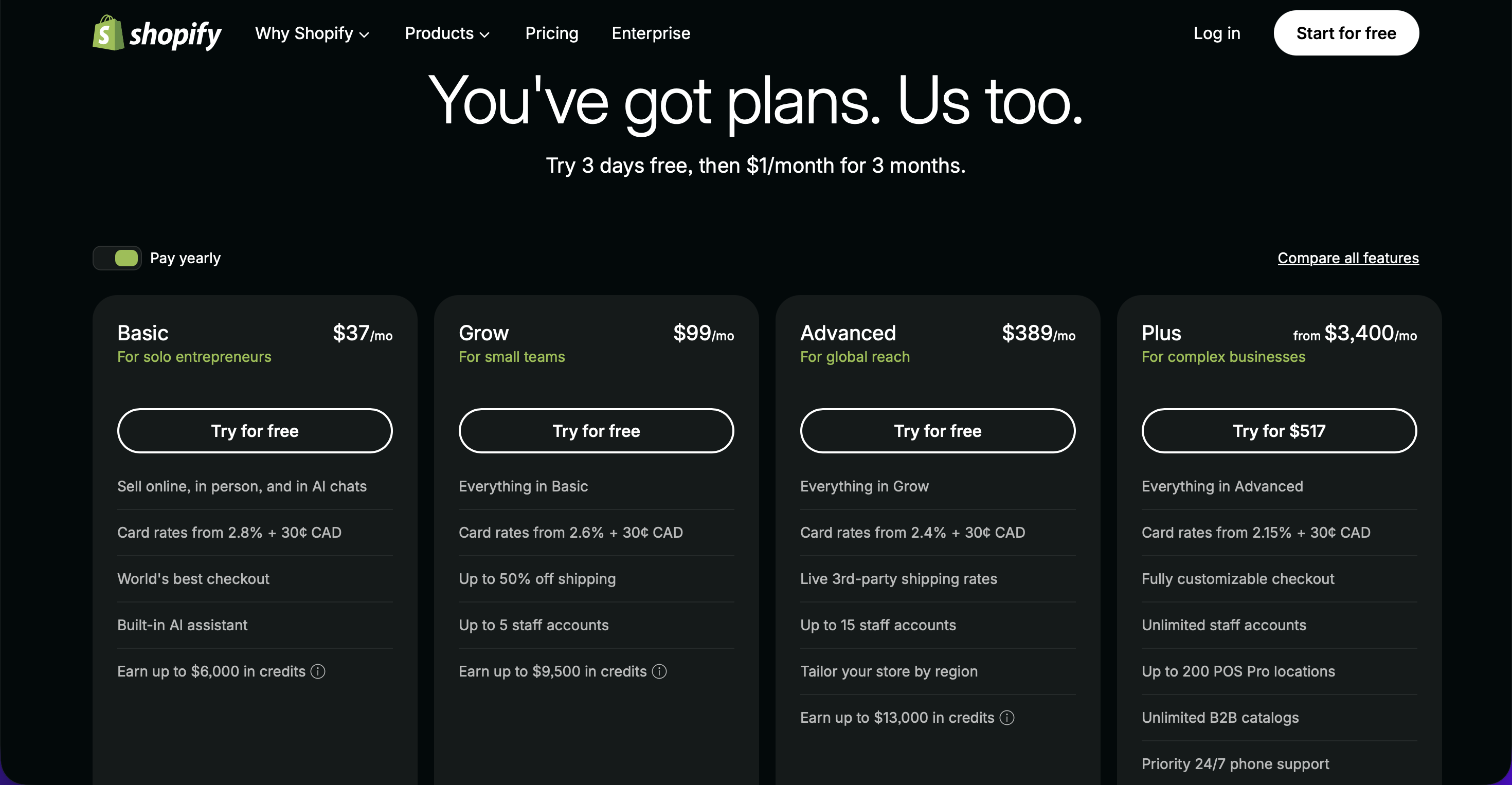
Shopify and Neto offer tiered pricing plans, with subscription costs increasing as functionality becomes more advanced. The total cost of ownership (TCO) will depend on your business size and maturity, required functionality, and reliance on third-party apps.
Neto has a higher starting investment, but it offers more operational functionality within the core unified platform, where inventory management, orders, purchasing, fulfilment, B2B workflows, marketplaces, POS, and shipping all work together in one system. On top of that, unlike Shopify, Neto doesn’t charge transaction fees. Overall, because fewer third-party tools and integrations are needed to run daily operations, Neto often delivers a lower total cost of ownership over time.
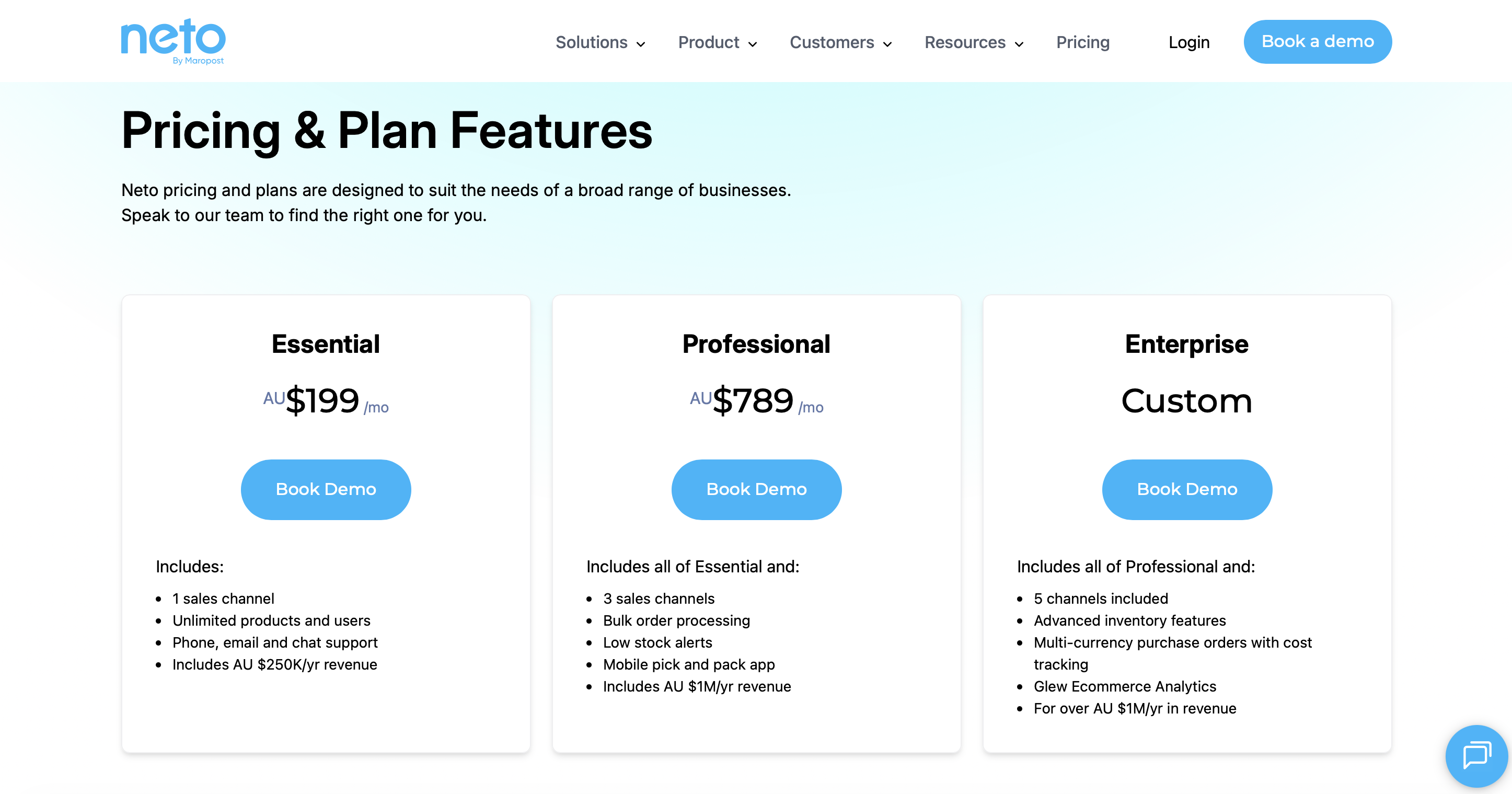
Shopify is often perceived as a budget-friendly choice at an entry-level, making it appealing for smaller merchants. Over time, though, growing businesses usually require more sophisticated features, which are only available through additional integrations and third-party tools, driving up the overall monthly spend. Plus, on top of plan fees, Shopify also charges transaction fees unless you’re using Shopify Payments. In the long run, this can make Shopify more expensive than it first appears.
Frequently Asked Questions (FAQ)
Can I migrate from Shopify to Neto?
Yes, you can easily migrate from Shopify to Neto. Start by exporting your products, customers, and order history from Shopify as CSV files, then import them into Neto using the built-in data import tools. Neto also provides a staging environment to test everything before going live, helping minimise disruption. You can manage the migration yourself or work with Neto’s team and certified partners for additional support.
Does Neto charge transaction fees?
No, Neto does not charge transaction fees on purchases made on the Neto platform. You only pay the standard fees charged by your chosen payment gateway (e.g., Stripe, PayPal, eWay, etc.), but Neto itself does not add an extra percentage or “penalty” on top of those fees.
How do Neto and Shopify compare on customer support?
Shopify offers 24/7 global support across multiple channels, but Neto is built with Australian businesses in mind. It delivers more relevant, region-specific assistance tailored to how Australian merchants actually run their businesses.
Neto or Shopify? Choosing the right commerce platform for your growth
Neto and Shopify are both popular ecommerce platforms in Australia – and both can support growing retail and ecommerce businesses. But the difference becomes visible once your business starts to grow and your operational complexity increases.
Are you an ecommerce startup or a small business looking to start selling quickly and want maximum flexibility through an extensive ecosystem of apps? Go for Shopify. It also works well for Australian brands planning to expand beyond their local market and sell internationally.
Are you running a high-volume ecommerce or retail operation and looking to reduce your reliance on third-party apps? Do you need a more centralised control over your inventory, purchasing, warehousing, and multi-channel selling without stitching everything together through multiple systems? Are B2B workflows, marketplace integrations, and fulfilment precision critical to your growth? Is operational depth and a single source of truth matter more than storefront flexibility and customisation? Go for Neto.
The choice ultimately depends on your business size, maturity, the level of operational control you need, and how much complexity you expect to manage as you scale – not just today, but long term.
Book a demo now to see Neto in action and learn how it can help you reduce reliance on third-party apps and lower total cost of ownership by bringing core ecommerce and retail operations into a single unified commerce platform – built for Australian businesses.