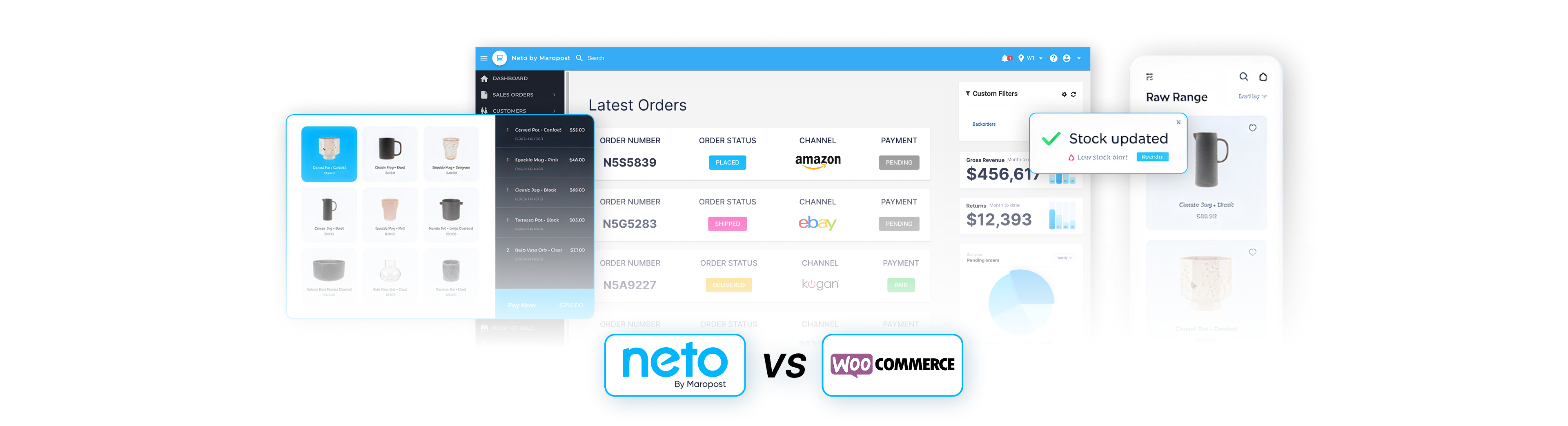
Neto vs WooCommerce: full operational control
beyond just store customisation
and multi-channel control – all in one platform.
Neto vs. WooCommerce at a glance
| Built-in Capability | Neto | WooCommerce |
| Storefront creation and customisation |
|
|
| Hosting & performance management |
|

|
| Centralised inventory control |
|
Plugin/ app dependent |
| Multi-location inventory |
|
Plugin/ app dependent |
| Purchase order management |
|
|
| Landed cost tracking |
|
|
| Order routing management |
|
Plugin/ app dependent |
| Warehouse workflows |
|
Plugins/third-party tools |
| Shipping & label creation |
|
Plugin dependent for advanced rules |
| B2B portals |
|
Plugin dependent |
| Customer-specific pricing |
|
Plugin dependent |
| POS integration |
|
|
| Real-time inventory sync |
|
![]() App-dependent |
| Marketplace integrations |
|
![]() App-dependent |
| Custom integrations/ APIs |
|
![]() Connector based |
How Neto compares to WooCommerce and where
it stands out for ecommerce businesses
Enables you to handle core ecommerce operations in a single platform
Lets you extend operational functionality without adding multiple plugins/ apps
Reduces total cost of ownership for operations-led ecommerce businesses
Leads in supporting B2B and multi- channel selling by default
Eliminates reliance on third-party vendors/ agencies to maintain workflows
Upgrade to an ecommerce platform
built for your operational complexity
Frequently asked questions
-
What are Neto’s advantages over WooCommerce?
Neto’s primary advantage over WooCommerce is its operations-led architecture. It centralises inventory, purchasing, order management, fulfilment, B2B, and marketplace workflows within one platform, reducing reliance on plugins and external systems. This leads to less operational fragmentation and clearer ownership of core processes. Neto is particularly strong for inventory-led, multi-location, and multi-channel businesses where accuracy and workflow control directly impact revenue and margin.
However, businesses that rely on the WordPress ecosystem, prioritise bespoke front-end flexibility, or have simpler ecommerce requirements may find WooCommerce a better fit.
-
Is Neto better for Australian businesses?
Neto is a strong fit for Australian businesses that manage complex inventory, wholesale, marketplaces, or combined online and in-store operations. It excels for local businesses that treat ecommerce as their core operational backbone rather than just a marketing storefront. Plus, it offers native, out-of-the-box integrations with Australian couriers (like Australia Post and StarTrack), regional marketplaces, and built-in support for local tax rules – capabilities that WooCommerce handles through plugins and third-party apps.
-
Why should I switch from WooCommerce to Neto?
Switching to Neto makes sense when WooCommerce starts to feel operationally fragmented, with inventory, purchasing, B2B, and marketplace workflows spread across plugins and external systems. Neto brings these core functions into one platform, reducing complexity, technical debt, and long-term overhead. If your business has outgrown a plugin-driven architecture and needs reliable operational control to scale, Neto is built to support that next stage of growth.