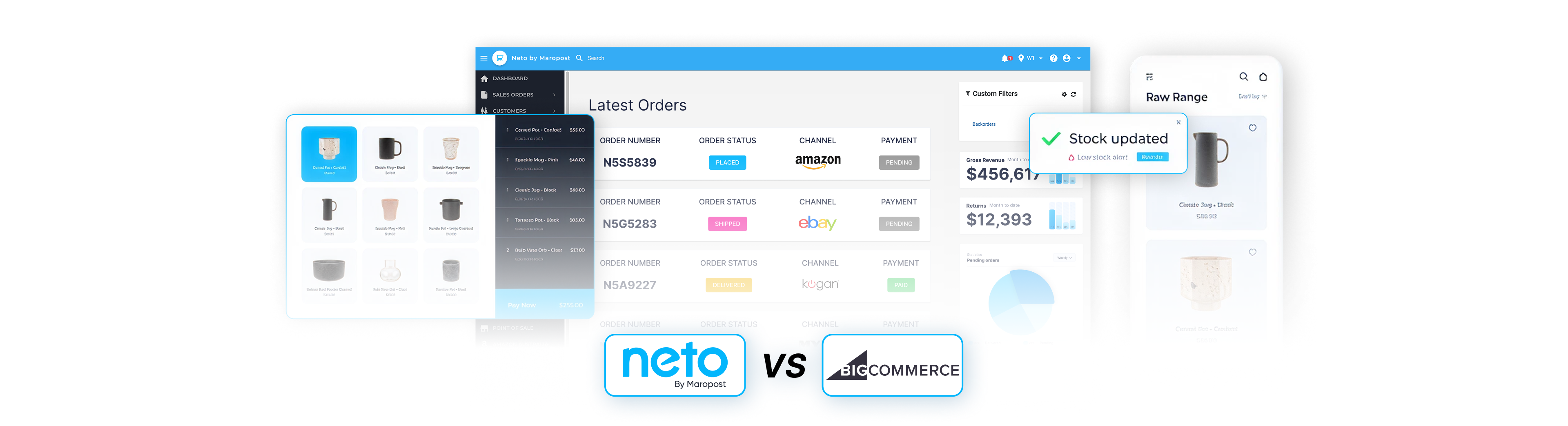
Neto vs BigCommerce: scale with the platform
built to eliminate operational chaos
Neto vs. BigCommerce at a glance
| Built-in Capability | Neto | BigCommerce |
| Storefront creation and customisation |
|
|
| Multi-location inventory management |
|
|
| Purchase order management |
|
![]() Third-party tools |
| Landed cost tracking |
|

|
| Shipping & label creation |
|
![]() App-dependent |
| Demand forecasting |
|
|
| Bulk order processing |
|
Limited B2B portals |
| Limited B2B portals |
|
![]() App-dependent |
| Customer-specific pricing |
|
|
| POS + ecommerce inventory sync |
|
![]() Integrations dependent |
| Multi-store operations |
|
![]() Third-party tools |
| Single operational view |
|
|
| Marketplace integrations |
|
![]() App-dependent |
| Custom integrations/ APIs |
|
![]() Connector based |
How Neto compares to BigCommerce and why operations-led businesses choose it
Excels where full operational control
is non-negotiable
Built for businesses that want to scale with fewer apps
Lowers total cost of ownership as your business grows
Simplifies B2B selling and marketplace management
Reduces vendor dependency and enables faster issue resolution
From API-centric to operations-first: switch to a platform that simplifies operational complexity
for a change. Neto is built for operations-heavy businesses that need their platform to act as the operational backbone – not just the storefront.
Frequently asked questions
-
When is Neto the better choice over BigCommerce?
While BigCommerce is often better for teams prioritizing API-first flexibility, headless builds, and external systems to handle operations, Neto is the stronger option for operations-heavy businesses that rely on their ecommerce platform to run and coordinate core operational processes. It’s particularly well-suited to companies where inventory accuracy impacts margins, stock is distributed across multiple locations, warehouse processes are handled in-house, and B2B or marketplace sales are central to revenue.
-
Which platform is better for Australian businesses: Neto or BigCommerce?
For Australian businesses, Neto is the stronger choice because it was engineered specifically for the local market, offering native out-of-the-box integrations with Australian couriers (like Australia Post and StarTrack), regional marketplaces (like Catch and Kogan), and tax rules that global platforms often require third-party apps to handle.
In short, for operation-heavy Australian businesses needing a unified inventory + shipping + marketplace operations layer, Neto is a better option. Plus, with Neto, you gain access to a support team that operates in your time zone and understands specific local tax (GST), shipping, and compliance nuances.
-
Why should I switch from BigCommerce to Neto?
Switching to Neto eliminates the "app tax" and integration headaches of BigCommerce, where essential ecommerce operations and complex workflows often require expensive third-party apps and integrations. Overall, it’s a strategic move for businesses that want to reduce their dependency on fragmented third-party applications, switch to a more unified commerce ecosystem, and ultimately reduce the total cost of ownership.